Answer the actual question
Match the driver’s intent: immediate repair help, comparison, cost context, safety concern, or process guidance.
A driver may search for a dent, an insurer question, an OEM certification, or an ADAS warning light. We build a connected content system that answers each need clearly and leads to the next useful step.

A useful collision website explains the relationship between the damage, repair method, vehicle requirements, insurance process, estimate, and shop capability. Each page needs a clear purpose, accurate scope, and a path to related answers.
Match the driver’s intent: immediate repair help, comparison, cost context, safety concern, or process guidance.
Ground certifications, equipment, repair procedures, warranties, and locations in approved shop facts.
Use descriptive headings, concise answer blocks, useful visuals, and links that explain the relationship between topics.
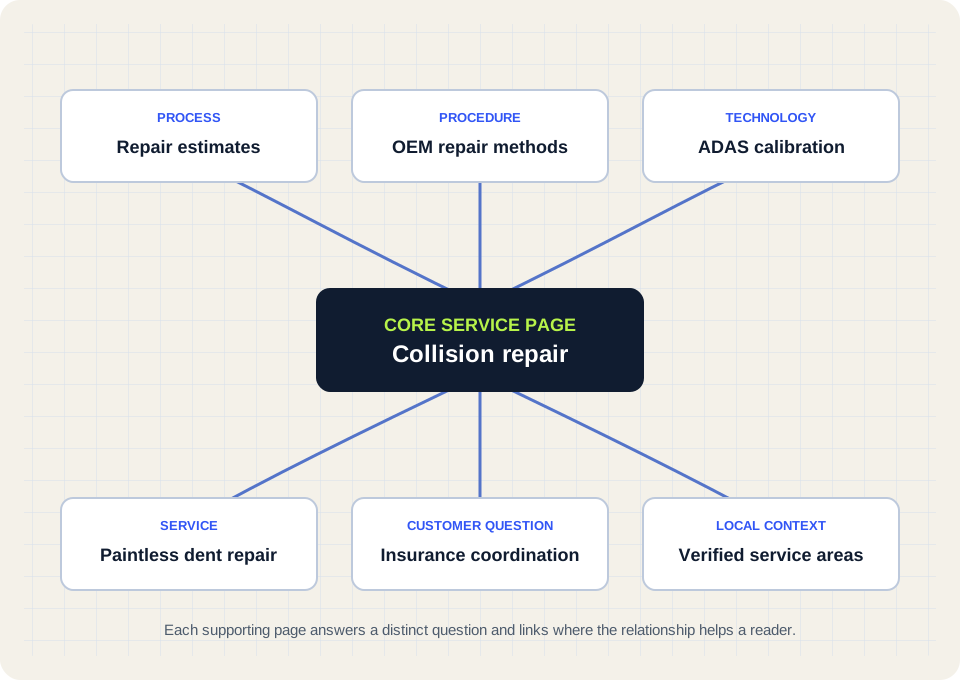
The map below is an illustrative planning model. The actual map is built from your verified services, service area, customer questions, and existing site content.
A main collision repair page explains the overall process. Supporting pages answer distinct questions such as ADAS calibration, OEM procedures, paintless dent repair, estimates, and insurance coordination. Links should help a reader move between related decisions.
We sequence the work so the content describes what the shop does, serves a distinct customer need, and can be reviewed after publication.
Inventory locations, service areas, vehicle makes, OEM certifications, repair equipment, ADAS capabilities, PDR, insurer relationships, estimate intake, and current proof. Mark anything unverified as a question for the owner.
Output: approved shop fact sheet and claim review list.Group search questions by damage, vehicle, procedure, urgency, geography, and decision stage. Compare those questions with current pages and Search Console data when available. Separate distinct intents instead of producing near-duplicate keyword or city pages.
Output: intent and entity map with page priorities.Choose a main service page and supporting pages with one primary job each. Define which answer belongs on which URL, where an existing page should be improved, and which internal links help a driver continue the repair journey.
Output: topical map, URL plan, and internal-link model.Specify the reader’s question, direct answer, needed sections, photos or diagrams, proof requirements, related pages, and contact action. Avoid generic filler, unsupported claims, and copied repair advice.
Output: page-level editorial briefs and source checklist.Write plain-language explanations of terms and processes. A qualified shop reviewer checks technical details, safety implications, certification language, insurer statements, and promises about estimates before anything goes live.
Output: approved, attributable page copy.Use a readable hierarchy, answer-first sections, descriptive links, relevant images with useful alternative text, and structured data only where it matches visible content. Check mobile layout, crawl access, canonical URLs, and form paths.
Output: published pages and quality-control log.Review indexing, relevant queries, page engagement, calls, forms, and shop-confirmed outcomes where available. Update pages when services, procedures, certifications, or customer questions change. Report observations without treating platform activity as repair revenue.
Output: editorial revision queue and outcome review.Scope and pricing are set after we review the shop’s site, services, markets, and review capacity.
Our primary conceptual reference is Koray Tuğberk GÜBÜR’s visual semantics and topical authority case study. That study concerns another type of website; its results are not Jazwal results or evidence of outcomes for collision shops. We adapt the principle of matching content, page structure, and useful page functions to a driver’s task.
These sources inform the approach; none endorses Jazwal or guarantees search performance.
We start with a driver’s question and the real repair process, then connect related concepts on pages that each have a distinct purpose. We do not create near-duplicate city or keyword variants simply to increase page count.
The shop or a qualified repair subject-matter reviewer must approve claims about repair procedures, OEM certifications, calibrations, insurer relationships, warranties, and service availability before publication.
No. A topical map is a planning tool. Search visibility depends on many factors, and we measure indexed pages, relevant queries, qualified inquiries, and content usefulness without promising a ranking or citation outcome.
Tell us where your shop’s growth feels stuck. We’ll review acquisition, estimate conversion, follow-up, and measurement, then identify the clearest next step.